

Monitoring AI-Critical Infrastructure
Continuous visibility helps operators identify power, temperature, humidity and other environmental issues before they develop into costly downtime. It is the shift from reactive maintenance to proactive infrastructure management.

You can’t protect what you can’t see
AI hardware is expensive, dense and unforgiving. A GPU cluster can pass from healthy to damaged in the time it takes for a cooling unit to fail or a power circuit to overload. The trouble is that most infrastructure failures don’t arrive without warning. They build up quietly:
- A rising inlet temperature at one rack that nobody is watching.
- A humidity drift that increases the risk of static discharge or condensation.
- A power circuit creeping toward its limit as more servers are added.
- A UPS battery slowly losing capacity, which only becomes obvious during an outage.
- A small water leak under a raised floor or near a cooling unit.
- A fan, filter or component wearing out between service visits.
- A fire detection or suppression system that hasn’t been inspected or tested as often as it should be.
In a reactive operation, these problems are discovered when something stops working. The cost is downtime, damaged hardware, lost AI workloads and an emergency call-out. In a data centre or server room that runs AI workloads around the clock, a single unnoticed fault can cost far more than the monitoring that would have caught it.
Many server rooms still depend on occasional manual checks, a thermostat on the wall, or alarms that nobody sees after hours. As densities rise, that approach leaves too much to chance.
What the infrastructure needs
Monitoring AI-critical infrastructure is more than installing a few sensors. It rests on two things working together: continuous visibility, and a maintenance approach that acts on what the data shows.
Continuous data centre and server room monitoring
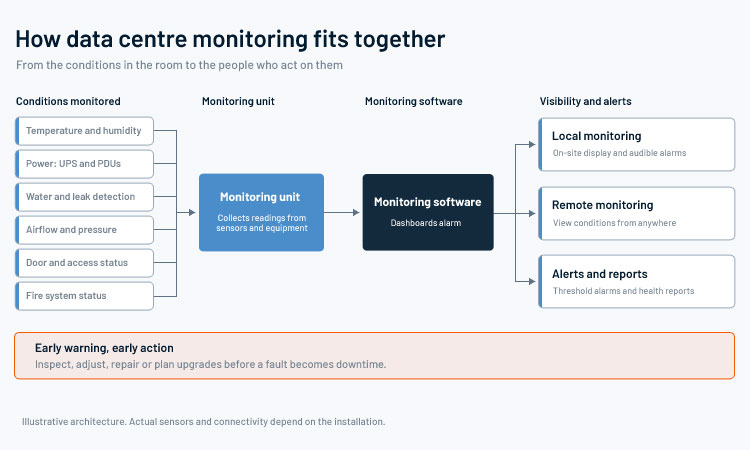
Effective data centre monitoring covers every condition that can affect uptime. At a minimum, that means:
- Temperature, ideally measured at rack inlet level and at several heights, not just a single room reading.
- Humidity, kept within the range recommended for your equipment.
- Power, including consumption, load and the state of your UPS, PDUs and generator.
- Water and leak detection, particularly around cooling units and under raised floors.
- Airflow and pressure, to confirm cooling is reaching the equipment.
- Security and access, such as door contacts, and the status of the room.
- Fire detection and alarm status, so the condition of the fire system is visible alongside everything else.
Local and remote monitoring
Monitoring has to work in two places. Local monitoring gives staff on site immediate indication through local displays, audible alarms and on-site software. Remote monitoring lets your team, or a service provider, see conditions from anywhere, which matters for unattended server rooms, edge sites and after-hours coverage. The best set-up uses both, so a local fault is visible on site and a problem at 2 am doesn’t depend on someone walking past the room.
Alerting and reporting
Data is only useful if the right person sees it in time. Good alerting includes:
- Thresholds with warning and critical levels, so you’re alerted to a trend before it becomes an emergency.
- Multiple notification routes, such as email, SMS or integration with other management systems.
- Escalation, so an unacknowledged alarm reaches someone else.
- Event logging, which provides a record of what happened and when.
Reporting turns the same data into something you can plan with: trends in temperature and power use, evidence of how the environment has performed, and early signs of capacity limits or equipment ageing. Regular infrastructure health reporting also makes conversations with management, auditors and insurers easier.
From reactive to proactive maintenance
Monitoring tells you what’s happening now. Maintenance determines how reliable the equipment will be next year. A mature approach has three layers:
- Reactive maintenance fixes things after they fail. It is the most disruptive and often the most expensive.
- Preventative maintenance schedules regular servicing, cleaning and inspections based on time or usage, so components are looked after before they fail.
- Proactive (condition-based) support uses monitoring data to spot developing faults, recommend action and plan upgrades before there’s an outage.
For AI infrastructure, the aim is to move as far toward the proactive end as possible. Regular equipment inspections, cleaning (dust affects cooling and electronics), repairs and fire system maintenance keep the physical plant in good condition, while monitoring shows when attention is needed between visits.
Lifecycle support
Infrastructure ages. UPS batteries lose capacity, filters clog, fans wear and fire system components need periodic testing and replacement. Lifecycle support means tracking the age and condition of critical equipment, planning replacements before end of life, and keeping documentation current, so ageing equipment doesn’t become the weak link in a high-value AI environment.
How Modac can help
Modac combines monitoring products with hands-on data centre support, so the same team that helps you see problems can help you prevent and fix them.
Monitoring solutions
Axil P194 Monitoring Units
Monitoring units that collect environmental and infrastructure data from your data centre or server room, forming the foundation of continuous visibility.
AxilView Monitoring Software
Software that brings monitoring data together in one place, with dashboards, alarm management and history, so your team can see the state of the facility at a glance.
Local and Remote Monitoring
Visibility on site and from anywhere, so your server room is watched whether or not someone is in the building.
Alerting and reporting services
Timely alarms that reach the right people, plus infrastructure health reporting that shows trends, performance and emerging risks.
Maintenance and lifecycle support
Proactive support
Support that uses monitoring insight to identify and address issues before they cause downtime, moving your operation from reactive to proactive.
Preventative maintenance
Scheduled servicing of your critical infrastructure to keep it performing and extend equipment life.
Equipment inspections
Regular inspections that assess the condition of your power, cooling and environmental systems and flag anything that needs attention.
Cleaning and repairs
Cleaning of the data centre environment and equipment, and repairs when something does need fixing, to keep airflow, cooling and electronics in good order.
Remote monitoring
Ongoing remote oversight of your infrastructure, so developing problems can be spotted and acted on quickly.
Fire system maintenance
Maintenance of fire detection and suppression systems, helping keep this critical protection reliable and in good working order.
Infrastructure health reporting
Clear reporting on the condition and performance of your infrastructure, giving you the evidence to plan maintenance, upgrades and capacity.
Together, these services let Modac support your facility across its lifecycle, from design and installation through monitoring and maintenance to repairs and upgrades.


